
Water Heater Installation in Huntington Beach, CA
Huntington Beach Water Heaters provides water heater installation for Huntington Beach, California and the surrounding Orange County coast — tank, tankless, gas, electric and heat-pump systems installed, serviced and replaced to current plumbing, fuel-gas and seismic code.
Whether you're putting a water heater into a new build, moving one to a better location, or installing a different type than you had before, the installation details decide how well the system performs for the next decade. Here's what goes into a proper install in the Huntington Beach area.
Free Huntington Beach Water Heater Estimate
Share a few details about your unit and your home, and we will price the job for you — nothing owed either way.
New Installations vs. Replacement Installations
A replacement installation reuses the existing water, fuel and vent connections wherever they still meet code. It is the fastest kind of install and the most common one in established neighborhoods.
A new installation — an addition, a finished living space bathroom, a garage shop sink, or a second heater for a far-away bathroom — has to run new supply lines, a new drain path for the relief valve, and a new vent or circuit. There is more planning involved and more of the cost is labor rather than equipment.
If you're simply replacing what's already there, start with water heater replacement, which covers the decision side of the job in more depth.
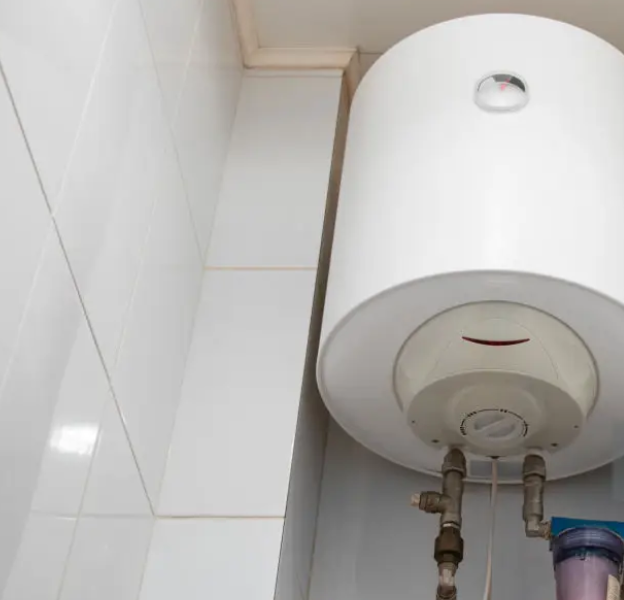
Tank, Tankless, Gas and Electric Installations
Tank system installs
The simplest installs. The unit sets on the floor or a platform, connects to cold and hot lines with flex connectors or hard pipe, and vents through the existing flue on gas models. A drain pan with a piped drain is a smart addition anywhere a leak could damage finished space.
Tankless system installs
Wall-mounted, and far more sensitive to installation quality. Condensing units need stainless or PVC venting depending on model, a condensate drain with neutralizer, isolation valves for future descaling, and adequate gas volume. Getting the vent termination and clearances right matters as much as the unit itself. See tankless water heaters.
Gas system installs
Atmospheric-vent units rely on natural draft through the chimney or flue; power-vent units use a blower and PVC through a sidewall, which opens up placement options in garages and utility areas where the existing flue is unavailable or unsuitable. Gas installs need a sediment trap, a proper shutoff, and a leak test on every joint. See gas water heaters.
Electric system installs
No combustion air, no flue — but a dedicated circuit sized to the unit and, for heat pump models, enough surrounding air volume and a condensate drain. Heat pump water heaters do best in a garage or utility area with several hundred cubic feet of space around them. See electric water heaters.
Proper Sizing Before Installation
Sizing is where installations quietly succeed or fail. Two houses on the same street can need different equipment.
| System | What gets sized | What throws it off |
|---|---|---|
| Storage tank | Gallon capacity and first-hour rating | Simultaneous showers, large soaking tubs, laundry timing |
| Tankless | Gallons per minute at your required temperature rise | Incoming-water temperature and simultaneous fixture demand |
| Heat pump electric | Capacity plus surrounding air volume | Small closets, cold unconditioned spaces |
A good installer asks about your morning routine, the number of bathrooms, and whether anyone has ever run out of hot water. Those answers drive sizing more than square footage does.
Installation, Safety and Code Considerations
The parts of an install that homeowners rarely see are the ones that keep the system safe:
- Temperature and pressure relief valve with a correctly routed discharge pipe — never capped, never reduced in size.
- Thermal expansion control where a check valve or pressure reducing valve creates a closed system; that's what an expansion tank is for.
- Correct venting and adequate combustion air on fuel-burning units.
- Dielectric protection where dissimilar metals meet, to slow corrosion at the fittings.
- Drain pan and shutoff access so future service and leaks are manageable.
- Permit and inspection where the local jurisdiction requires one.
These are also the details a home inspector flags during a sale, which is a good reason not to cut corners on an install.
Installation Specifications Homeowners Should Recognize
First-hour rating (FHR)
The gallons of hot water a storage unit can deliver in a busy hour, combining stored volume with recovery. A 50-gallon gas tank commonly rates near 80–90 gallons FHR; the same tank in electric form rates far lower because element recovery is slower.
Uniform Energy Factor (UEF)
The federal efficiency metric printed on the rating plate. Atmospheric gas tanks land around 0.58–0.64, condensing tankless units above 0.90, and heat-pump electric units above 3.0 because they move heat rather than create it.
Vent category and termination
Category I atmospheric units use a Type B flue with natural draft; Category III and IV condensing appliances use sealed stainless or PVC with a listed sidewall termination and specified clearance to windows, soffits and property lines.
Closed-system components
A pressure reducing valve or backflow device makes the plumbing closed, so a bladder expansion tank pre-charged to static line pressure and a full-size T&P discharge line are part of a correct install rather than optional extras.
How a Huntington Beach Installation Day Runs
Work begins with isolation: cold-water inlet closed, gas cock shut or breaker locked out, tank drained through a hose to the driveway or a floor drain. Old flex connectors, dielectric nipples and the vent connector come off with the unit.
The new heater is set on a level pan, elevated or FVIR-listed for garage placement, restrained with strut-style seismic strapping at the upper and lower thirds, then reconnected with new stainless flex lines, a gas sediment trap and a full-size relief discharge routed to the exterior.
Startup covers a leak test on every joint, a soap test on gas connections, draft verification at the hood, thermostat set to 120°F, and a check that the expansion tank charge matches static pressure. Salt-air exposure near the coast is the reason coated or stainless hardware is worth specifying here.
Related Water Heater Services
Tankless Water Heaters
Conversion requirements and on-demand sizing.
Gas Water Heaters
Venting and gas supply for combustion units.
Electric Water Heaters
Circuits, elements and heat pump models.
Commercial Water Heater Installation
Capacity, redundancy and utility planning for business properties.
Huntington Beach-Area Communities We Cover
Installation requests are routed to professionals covering Huntington Beach and these nearby communities.
- Fountain Valley, CA
- Westminster, CA
- Costa Mesa, CA
- Seal Beach, CA
- Garden Grove, CA
- Newport Beach, CA
- Cypress, CA
- Los Alamitos, CA
- Stanton, CA
- Santa Ana, CA
- Irvine, CA
Frequently Asked Questions
How long does water heater installation take?
A standard tank installation usually takes two to four hours. Tankless installations and installs in a new location typically take six hours to a full day because venting, gas or electrical work is part of the job.
Can a water heater be installed in a different spot than the old one?
Often yes. Moving the unit means extending water lines, providing a relief valve drain path, and rerouting venting or a circuit — all doable, but it changes the scope and the quote.
Do I need an expansion tank?
If your home has a pressure reducing valve or backflow preventer on the service line, the plumbing is a closed system and thermal expansion needs somewhere to go. Many installs in the Huntington Beach area include an expansion tank for that reason.
What temperature should a newly installed water heater be set to?
120°F is the usual starting point — hot enough for household use and gentler on scalding risk and energy use. Households with specific health considerations sometimes set higher and add mixing valves.
Is a permit required for installation?
Requirements vary by municipality across the Huntington Beach area. Ask your installer to confirm local rules and to handle the permit and inspection if one is needed.
Can I install a water heater myself?
Gas, venting and electrical work carry real safety and code consequences, and DIY installation can affect the manufacturer's warranty. Most homeowners are better served having a licensed professional handle it.
Talk to a Huntington Beach Water Heater Pro
Tell us the make, the age and where the unit sits, and we will come back with pricing for the work — no strings attached.
Cannot tell which service applies? Pick Not Sure and describe the symptoms in your own words; sorting that out is part of the job.
Free Huntington Beach Water Heater Estimate
Share a few details about your unit and your home, and we will price the job for you — nothing owed either way.