Water Heater Repair in Huntington Beach, CA
Huntington Beach Water Heaters provides water heater repair for Huntington Beach, California and the surrounding Orange County coast — tank, tankless, gas, electric and heat-pump systems installed, serviced and replaced to current plumbing, fuel-gas and seismic code.
Most water heater problems trace back to a short list of causes. Knowing which one you're looking at tells you whether you need a quick repair, a maintenance visit, or a conversation about replacement.
Free Huntington Beach Water Heater Estimate
Share a few details about your unit and your home, and we will price the job for you — nothing owed either way.
Common Water Heater Problems and What They Mean
No hot water at all
On a gas unit, this usually means the pilot or igniter is out, the thermocouple has failed, or the gas control valve is dead. On an electric unit, the most common cause is a tripped high-limit switch (the red reset button) or a failed upper heating element. A tripped breaker is worth checking first.
Not enough hot water
Runs out faster than it used to? Suspect sediment stealing tank volume, a failed lower element on an electric unit, a dip tube problem, or a thermostat set too low. If it's never been enough since the day it was installed, the tank may simply be undersized.
Popping, rumbling or crackling noises
That's water boiling under a layer of hardened sediment on the tank floor. Very common with mineral-rich water. A water heater flush is the first move; a tank that has been rumbling for years may already be heat-stressed.
Leaking
Trace the water before assuming the worst. Leaks at the drain valve, relief valve, or the cold and hot connections are repairable. Seepage through the welded shell itself is not. See water heater leak repair.
Pilot light won't stay lit
Typically a failing thermocouple or flame sensor, a dirty pilot orifice, or a blocked combustion air intake screen. A pilot that repeatedly goes out after being relit needs a real diagnosis, not another match.
Heating element failure
Electric tanks use two elements. Lose the lower and you get a small amount of hot water; lose the upper and you get essentially none. Elements are a routine, affordable replacement.
Thermostat problems
Water that is scalding, lukewarm, or swings unpredictably usually points at a thermostat that has drifted or failed, or at poor contact against the tank wall.
Pressure relief valve discharge
A relief valve that weeps or dumps water is doing its job — the question is why. Excess pressure, thermal expansion in a closed system, or an overheating tank all trigger it. Never plug it.
Sediment and corrosion
Sediment reduces efficiency and capacity. Corrosion at the fittings can be addressed; corrosion on the tank shell means the unit is on borrowed time and replacement is the honest recommendation.
How a Repair Visit Usually Goes
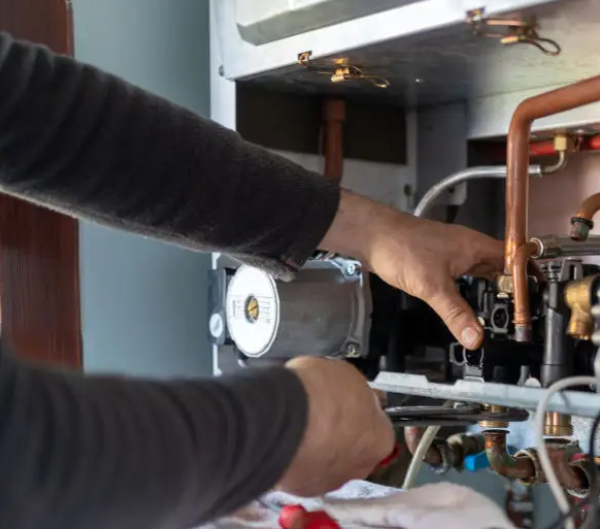
A technician will confirm the symptom, check fuel or power supply, read temperatures at the tank, inspect the venting and burner on gas models or test elements and thermostats on electric models, and check the relief valve and connections for leaks.
From there you should get a clear answer: what failed, what the repair involves, and — importantly — whether the repair makes sense given the age of the unit. On a 13-year-old tank, replacing a gas control valve often costs more than the remaining life is worth.
Repair or Replace? A Practical Way to Decide
- Under 8 years old, single component failure — repair is usually the right call.
- 8 to 12 years, second or third repair — get replacement pricing before authorizing the repair.
- Any age, leaking from the tank body — replacement, without exception.
- Repair quote approaching half of a new install — replacement typically wins on value.
- Household outgrew the unit — a repair won't fix an undersized tank.
If your unit is borderline, maintenance can buy time, but it doesn't reverse corrosion.
Diagnostic Sequence and Component Testing
Electric units
Voltage at the terminal block, continuity and resistance across each element (typically 10–16 ohms for a 4500W element), high-limit ECO switch state, and thermostat calibration against measured outlet temperature.
Gas units
Thermocouple millivolt output (roughly 25–30 mV open-circuit on a healthy unit), gas control valve response, manifold pressure, burner flame quality, and draft at the hood using a smoke or match test.
Delivery problems
A collapsed or cracked dip tube mixes cold water into the outlet; sediment on the floor of the tank reduces usable volume; a crossed connection at a mixing valve or single-handle faucet can mimic a heater fault entirely.
Repair Versus Replacement Economics in Huntington Beach
The practical rule is unit age against repair cost. Under eight years, a thermocouple, gas valve, element or thermostat repair usually returns full service life. Past twelve years, especially with scale-hardened sediment and a depleted anode, the same repair buys months rather than years.
Coastal properties reach that tipping point earlier because marine air corrodes the jacket, vent connector and strapping hardware from the outside while hard groundwater works on the inside. Where the tank shell itself is weeping, no repair holds and replacement is the only safe outcome.
Related Water Heater Services
Water Heater Leak Repair
Finding the source and deciding on next steps.
Water Heater Maintenance
Annual service that prevents repeat repairs.
Emergency Service
Active leaks and total hot water loss.
Commercial Water Heater Repair
Diagnostics for business hot-water systems and controls.
Huntington Beach-Area Communities We Cover
Repair requests are matched with professionals covering Huntington Beach and the surrounding area.
- Fountain Valley, CA
- Westminster, CA
- Costa Mesa, CA
- Seal Beach, CA
- Garden Grove, CA
- Newport Beach, CA
- Cypress, CA
- Los Alamitos, CA
- Stanton, CA
- Santa Ana, CA
- Irvine, CA
Frequently Asked Questions
Why does my water heater keep running out of hot water?
The usual suspects are sediment buildup reducing usable tank volume, a failed lower heating element on an electric unit, a broken dip tube, or a tank that is simply too small for current household demand.
Is a leaking water heater always a replacement?
No. Leaks at the drain valve, relief valve or supply connections are often repairable. Water coming from the tank body itself means the steel shell has corroded through and the unit needs to be replaced.
Why is my water heater making a rumbling noise?
Sediment has hardened on the bottom of the tank and water is boiling underneath it. A flush often quiets it and restores efficiency; long-term buildup can shorten tank life.
How often do heating elements fail?
Elements are consumables. In hard water they can scale and burn out within a few years, and they are among the least expensive water heater repairs.
My pilot light keeps going out — is that dangerous?
It signals a fault worth diagnosing rather than ignoring: a failing thermocouple, a dirty pilot assembly, or restricted combustion air. Any suspicion of a gas smell should be treated as an emergency and reported to your gas utility immediately.
Can regular maintenance prevent repairs?
It prevents some of them. An annual flush, an anode inspection and a relief valve test address the failure modes that account for a large share of service calls.
Talk to a Huntington Beach Water Heater Pro
Tell us the make, the age and where the unit sits, and we will come back with pricing for the work — no strings attached.
Cannot tell which service applies? Pick Not Sure and describe the symptoms in your own words; sorting that out is part of the job.
Free Huntington Beach Water Heater Estimate
Share a few details about your unit and your home, and we will price the job for you — nothing owed either way.